Most homeowners start a kitchen remodel thinking the hard part is picking cabinets and countertops. Seven weeks later, they've been through three rounds of unexpected costs, two surprise inspections, and a moment when the dishwasher didn't fit because someone ordered the wrong rough-in. The hard part is never the finishes — it's the order of operations, the hidden surprises behind old Oakland walls, and knowing which decisions can be changed cheaply versus which ones lock in everything that comes after.
This is the complete guide we give to every homeowner who sits down with us in Oakland. Real 2026 pricing, the actual construction sequence we follow, what we find behind the walls in 1920s bungalows and 1950s ranches, what layout changes really cost, and a realistic timeline from the day you sign a contract to the day you're doing dishes at your new sink.
The Real Cost of an Oakland Kitchen Remodel (3 Tiers)
Every Oakland kitchen remodel falls into roughly one of three tiers, depending on how much you're changing and how much you're keeping. Here's what a typical 150–250 square foot kitchen runs at each level in 2026, with real numbers.
Oakland Kitchen Remodel — 2026 Cost Tiers
| Tier | What's Included | Typical Range |
|---|---|---|
| Light Refresh | New counters, backsplash, paint, fixtures, cabinet hardware. Keeps existing cabinets, flooring, layout. | $15,000–25,000 |
| Mid-Range | New cabinets, counters, flooring, lighting, fixtures. Same footprint, no layout changes, no major electrical or plumbing work. | $40,000–65,000 |
| Full Gut | Everything above + layout changes, electrical panel upgrade, plumbing relocation, possible wall removal, permits. | $80,000–120,000 |
The typical sweet spot: most of the full kitchen remodels we do in Oakland land somewhere in the $60,000–$100,000 range — between mid-range and full gut. That's where clients want real upgrades (new cabinets, new flooring, maybe a sink relocation or an island addition) without a complete structural reconfiguration. It's also the tier where permits usually come into play and the timeline stretches to 8–14 weeks. We'll cover both in detail below.
For the full countertop walkthrough — materials, install sequence, seam placement, what we refuse to do — see our complete guide to countertops in Oakland. For the pricing deep-dive specifically, see how much kitchen countertops really cost in Oakland. Countertops alone can be anywhere from $3,500 to $15,000 depending on material and square footage, and they're often the single biggest line item in the finishes budget.
The Construction Sequence — 12 Phases, and Why Order Matters
The order we do things isn't random. Every phase depends on the one before it, and skipping or reordering a phase either costs money later or risks damaging finished work. Here's the real sequence we follow on almost every full Oakland kitchen remodel.
Remove old cabinets, counters, flooring, baseboards, drywall, and appliances. Haul off old materials, sweep the subfloor, and do first-pass inspection for rot, galvanized plumbing, and wiring surprises.
With walls open, we reroute supply lines, replace galvanized with copper or PEX if needed, rerun electrical for new appliance locations, and add circuits for code-required devices (dishwasher, disposal, induction cooktop).
Oakland Building Department inspects the rough plumbing and electrical before anything gets closed back up. This is a hard stop — no drywall until we pass.
Close up the walls, tape and texture, prime, and get the first coat of paint on. We do the first coat before flooring lands so we don't have to protect a finished floor from ceiling drips.
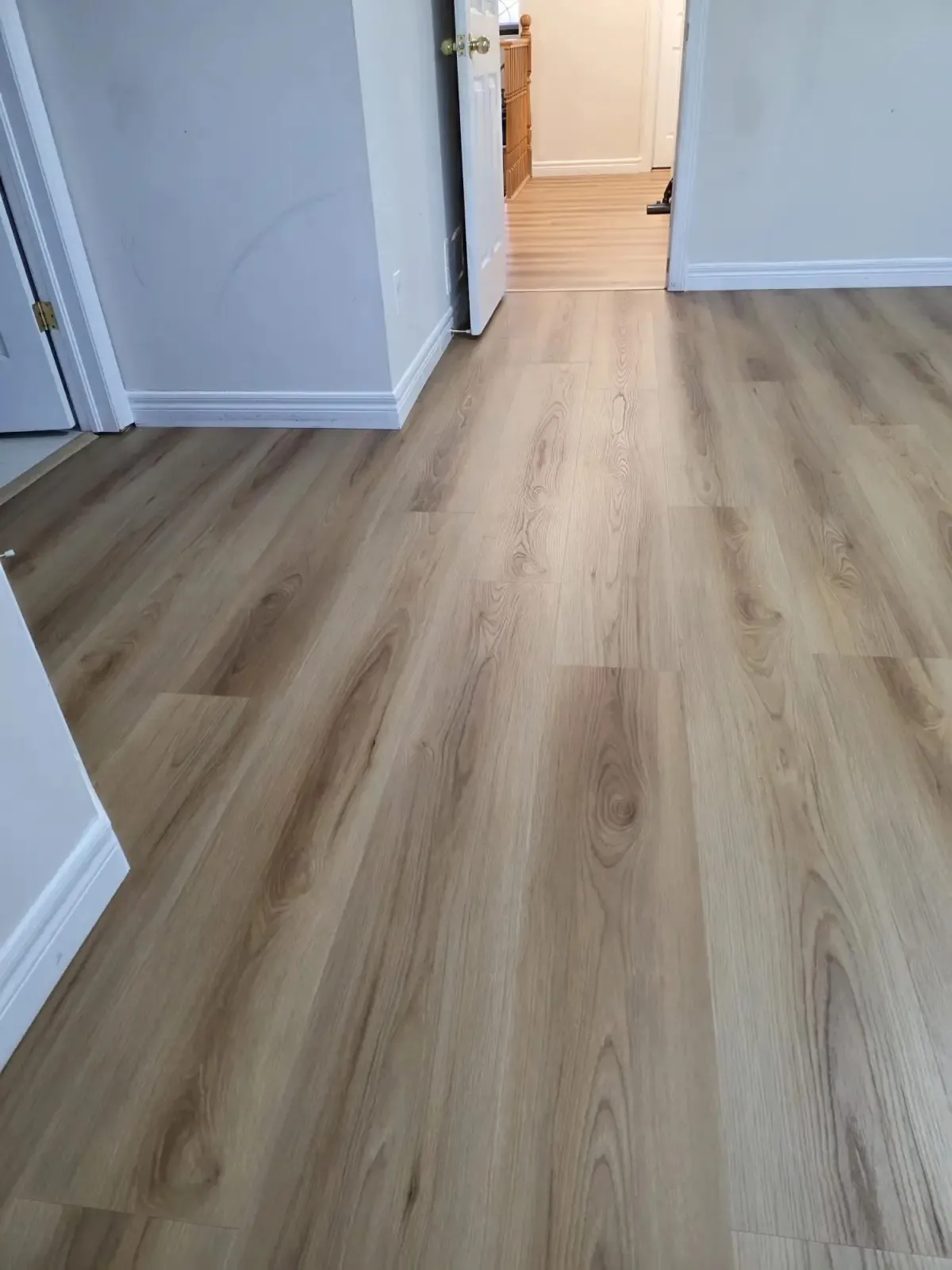
Hardwood, LVP, or tile goes in across the entire room footprint — including under where the cabinets will land. Ram Board protection goes down immediately, taped at every seam, and doesn't come up until the last appliance is in.
Cabinets sit on top of the finished flooring. If the layout ever changes in the future, the floor underneath is continuous — no weird patch lines where cabinets used to be.
The fabricator comes out with a laser template of the installed cabinets. Then there's usually a 3–5 day gap while they cut, polish, and edge the stone.
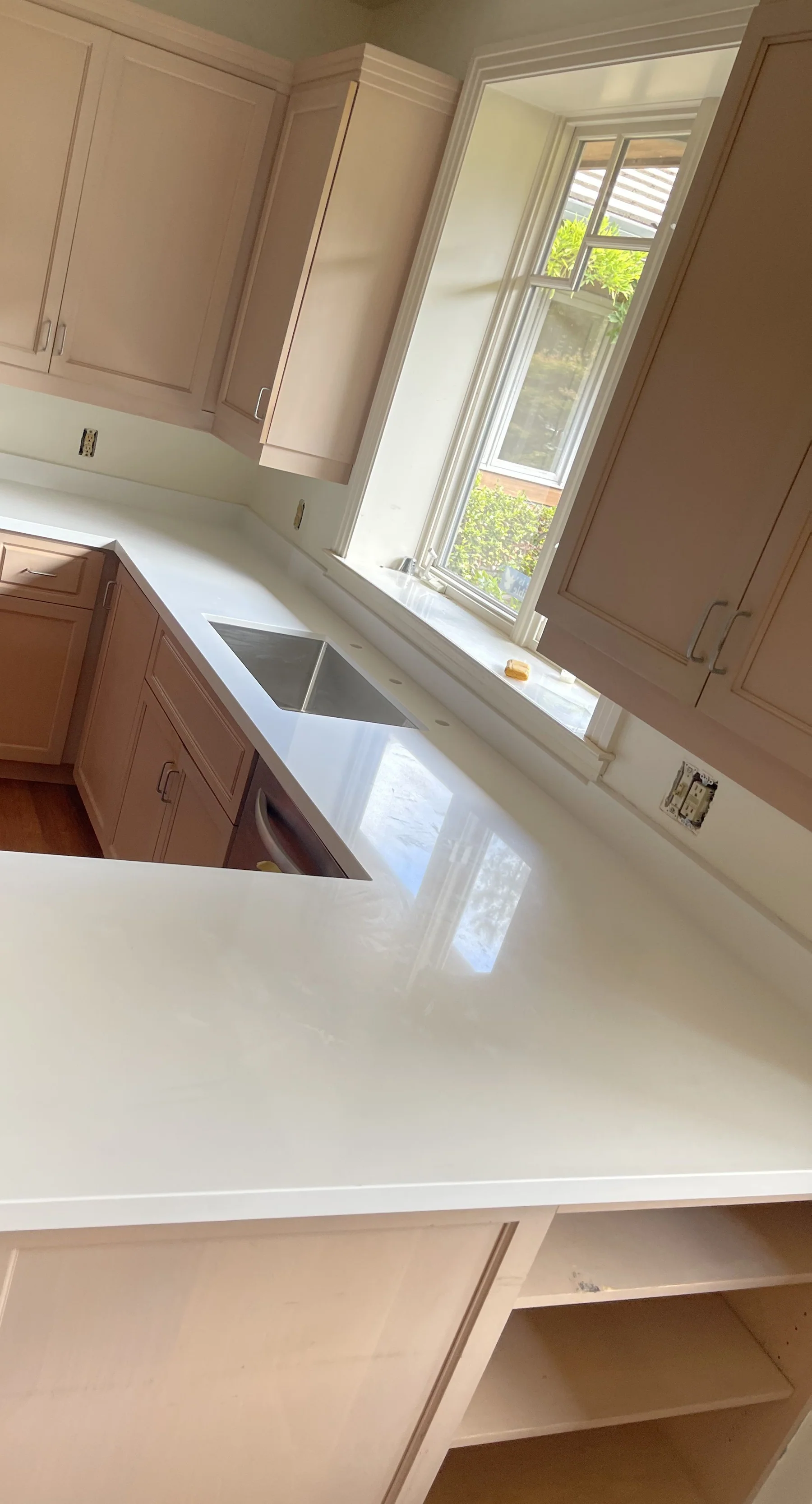
Fabricator delivers and sets the finished stone on the cabinets, seams it, caulks, and leaves it to cure.
Tile the backsplash against the installed counters. We usually do this after counters because the tile needs a clean reference line at the countertop edge.
Install the sink, faucet, disposal, under-cabinet lights, switches, outlets, and any pendant fixtures. This is the "make it work" phase.
Refrigerator, range, dishwasher, hood, microwave. Dishwasher connects now, not earlier, because it shares plumbing with the sink we just installed.
Touch up paint where we scuffed during install, pull the Ram Board, clean, punch out any small items on the client list, and schedule the final city inspection if permits were pulled.
The single most important thing in this sequence is Phase 5 — flooring goes in before cabinets, not around them. We wrote a whole post on the $4,200 baseboard mistake that we got called in to fix when another contractor installed GAIA Impala LVT the wrong way on an Oakland kitchen. If you read one post on kitchen flooring in this city, read that one.
What We Find Behind the Walls (and What It Costs to Fix)
Oakland is old. Rockridge craftsmans, Maxwell Park bungalows, Temescal Victorians, Montclair mid-century ranches — most of the homes we remodel predate World War II or were built before 1960. When we open the walls on demo day, the original everything is still in there, and it rarely looks the way the homeowner expected.
The single most common "oh shit" moment on an Oakland kitchen demo is rotted or corroded galvanized supply lines. Original galvanized steel pipes from the 1920s–1950s rust from the inside out for 50+ years until the inner diameter is half what it used to be. Water pressure at the sink is the first symptom — the homeowner lived with it for years and never knew why. Once we open the walls and see the pipes, we almost always recommend a full copper or PEX repipe for the kitchen while everything is accessible. Typical cost add: $2,000–$5,000 depending on how much re-routing is needed and how many fixtures are involved.
Other surprises we hit on Oakland kitchen demos, in rough order of frequency:
- Rotted subfloor around the dishwasher and sink base. Slow leaks over 5–15 years. Usually $500–$1,500 to cut out the damaged section and sister in new plywood. See our flooring sequencing post for the full subfloor walkthrough.
- Knob-and-tube wiring hidden behind plaster. Pre-1950s homes. Insurance companies and city inspectors won't let you bury K&T in new drywall. Kitchen-scale rewire: $3,000–$7,000.
- Old electrical that can't handle modern appliances. Two-slot ungrounded outlets, not enough dedicated circuits for dishwasher + disposal + microwave + induction cooktop, no GFCI protection at the counter. We add circuits to the existing panel (if there's space) or swap in a larger panel within the existing service. Typical kitchen electrical upgrade: $1,500–$4,000.
- Non-permitted previous remodels. A wall the last owner removed without a permit turns out to have been load-bearing. Adds $3,000–$8,000 for structural engineering, beam, posts, and permit.
- Asbestos mastic under old vinyl flooring. Pre-1980 homes. Requires testing and often abatement before we can even start. $500–$2,500 if it tests positive.
None of these are your fault as a homeowner. They're the cost of remodeling a 90-year-old house. The good news: finding them during demo, with walls already open, is always cheaper than finding them after the cabinets are in. A real Oakland contractor plans for them, budgets for them, and tells you about them on day one — not on week four.
Layout Changes — Moving the Sink, Adding an Island, Opening the Kitchen
The most common kitchen remodel upgrade isn't new cabinets — it's a layout change. Clients want to move the sink under the window. Add an island. Remove the wall between the kitchen and the dining room. Each of these has a different cost reality, and it's the biggest lever that moves a mid-range remodel into full-gut territory.
Typical Layout Change Costs (on top of base remodel)
| Change | Typical Cost Add |
|---|---|
| Move the sink 5–8 ft (same wall or adjacent wall, short plumbing run) | $1,000–2,500 |
| Move the sink 10–15 ft (new supply lines + new drain run through joists) | $3,000–6,000 |
| Add a new island with sink + 2 electrical circuits | $4,000–8,000 |
| Remove a non-load-bearing wall (demo + drywall + paint restoration) | $2,000–4,000 |
| Remove a LOAD-BEARING wall (engineer + beam + posts + permit) | $6,000–15,000 |
The decision we walk clients through first is how far the sink is moving, and whether it's still over the existing drain. A sink that slides 5 feet along the same wall, where we can reuse the drain and only extend the supply lines, is a $1,500 upgrade that no homeowner regrets. A sink that moves to an island on the other side of the kitchen, where we're cutting into the joist bay and running new drain and new vent stack and new supply — that's a $5,000 decision that only makes sense if the new layout fundamentally changes how you use the kitchen.
Load-bearing wall removal is the decision with the biggest cost spread. Never remove a wall in an Oakland home without a licensed contractor and a structural engineer looking at it first. The risk isn't just cost — it's discovering mid-demo that the wall was holding up the ceiling joists and having to scramble for a beam on day two. We've been called in to fix this exact mistake from other contractors. It never ends well.
A Real Oakland Kitchen — The Marble Island Case Study
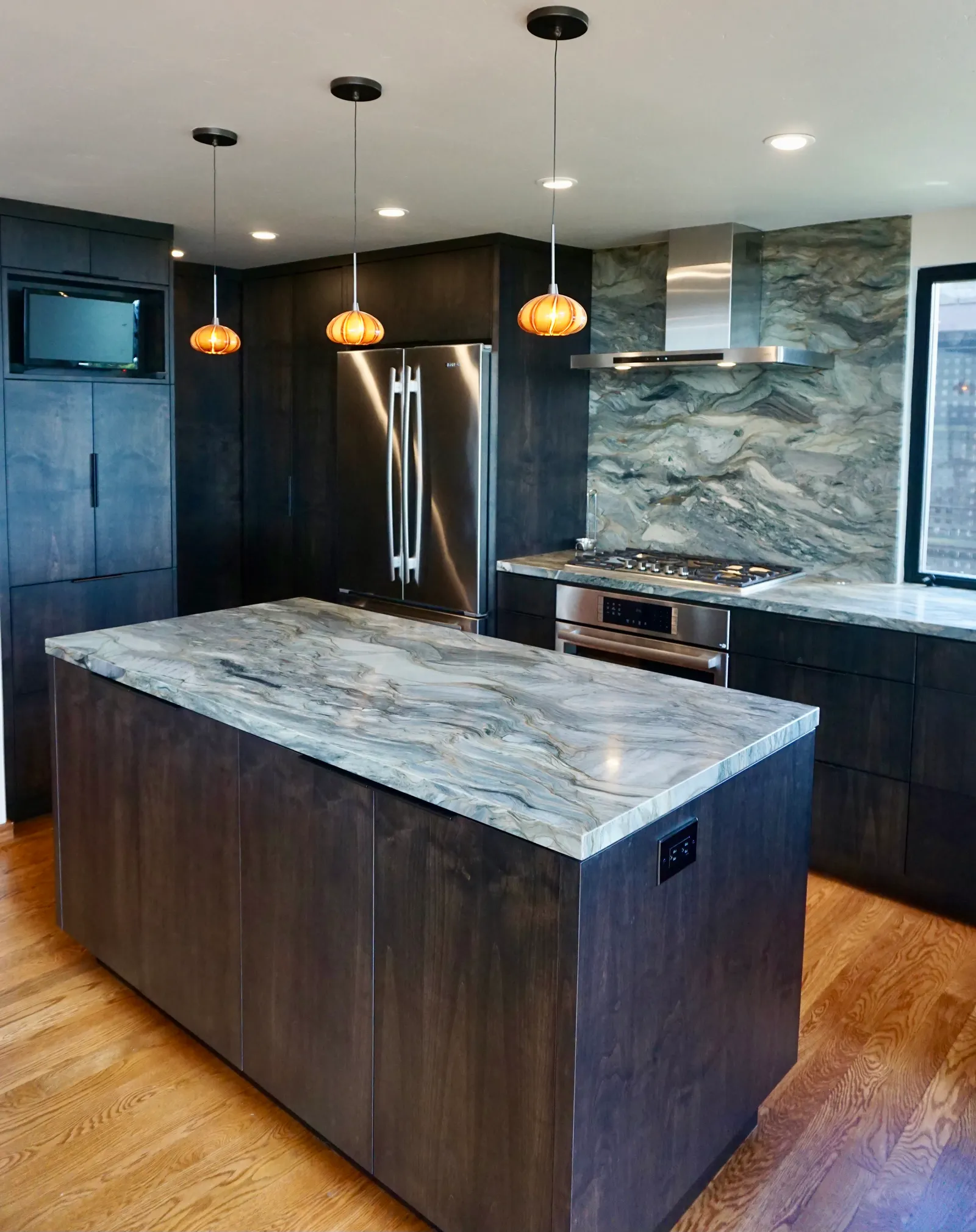
The kitchen at the top of this post is a project we did for a family in the Oakland hills. Dark-stained wood cabinets wrapping two walls, a big marble island running the length of the room with dramatic teal and grey veining, a full-height marble backsplash behind the range, three amber pendant lights over the island, stainless appliances, and the original hardwood floors refinished underneath. It's the project that made us say out loud, "we need to start taking better photos of our own work."
The clients for that kitchen were some of the best people we've worked with — the kind of homeowners who trusted the process, made decisions fast, and showed up on the last day with a bottle of wine instead of a punch list. The remodel itself landed in the $60K–$100K range — exactly the Oakland sweet spot — and ran about 10 weeks from contract to final walkthrough. One layout change (sink moved to face the island), one surprise (you guessed it, a short run of galvanized plumbing in the wall behind the old sink), and one permit cycle for the electrical upgrade.
For the full walkthrough on countertop materials, install sequence, and seam placement, see our complete guide to countertops in Oakland. For how we priced the countertops on that exact project, see how much kitchen countertops really cost in Oakland. For the material lineup we're using most in 2026 across all our kitchen jobs, see what we're installing in 2026.
Realistic Timeline — 8–14 Weeks From Contract to Dinner
Contract signed Monday. How many weeks until you're doing dishes at the new sink?
For the typical $60,000–$100,000 full Oakland kitchen remodel — the most common tier, with one layout change, an electrical upgrade, and at least one permit cycle — expect 8–14 weeks from contract signing to final walkthrough. Here's roughly how the weeks break down:
Sign contract, pay deposit, we pull permits from the Oakland Building Department. Permit issue usually takes 1–3 weeks depending on scope and how backed up the counter is.
Demo the kitchen to studs, rough in plumbing and electrical, schedule the rough-in inspection.
Close up the walls, first coat of paint, install flooring, install cabinets.
Template the day cabinets finish, then there's a 1–2 week fabrication gap (this is almost always the longest single wait in the remodel). Then install.
Tile the backsplash, hook up the sink, install under-cabinet lights, switch out the outlets, deliver the appliances, connect the dishwasher.
Paint touch-up, punch list items, final city inspection, walkthrough with the client.
The biggest bottleneck is almost always countertop fabrication — 1–2 weeks of nothing happening on site while the fabricator cuts, polishes, and edges the stone. Everything else in the schedule flexes around it. Cabinet lead time is the second-biggest — if you're ordering semi-custom cabinets, they can take 4–8 weeks from order to delivery, and they need to be on site before cabinet install week, which means the order goes in the day the contract is signed.
How to Choose a Licensed Kitchen Remodeling Contractor in Oakland
Kitchen remodels are the single biggest home investment most Oakland homeowners ever make short of buying the house itself. The contractor you pick determines whether you're happy or miserable for the next 8–14 weeks, and whether the finished kitchen lasts 5 years or 30.
- Confirm the CSLB license is active. California contractors must hold a valid license to perform work over $500. Look up any contractor at cslb.ca.gov. Soto Bay Construction holds CSLB License #1054501, active since 2019.
- Ask for the construction sequence in writing. A real contractor can walk you through the 12 phases above without flinching. If they can't explain when flooring goes in relative to cabinets, that's a red flag.
- Ask who does the electrical and plumbing. A general contractor should either have licensed sub-trades on the job or be licensed themselves for those categories. Unlicensed sub-trade work can void homeowner's insurance and fail inspection.
- Ask about hidden-cost contingency. A contractor who says "no surprises, flat price, final number" is either hiding them, not planning for them, or hasn't worked in a pre-1970 Oakland home. The honest answer is "we budget 10–15% contingency, you pay for what we actually find, and we tell you on the day we find it."
- Ask to see real finished work in the same neighborhood. Oakland's housing stock varies hugely by neighborhood — a Rockridge craftsman has different demo surprises than a Maxwell Park bungalow. A contractor who's worked your neighborhood has already seen what's behind your walls.
Thinking about a kitchen remodel in Oakland?
Licensed since 2019. Family-owned. Real Oakland projects, real pricing, real timelines.
Get a Free Estimate