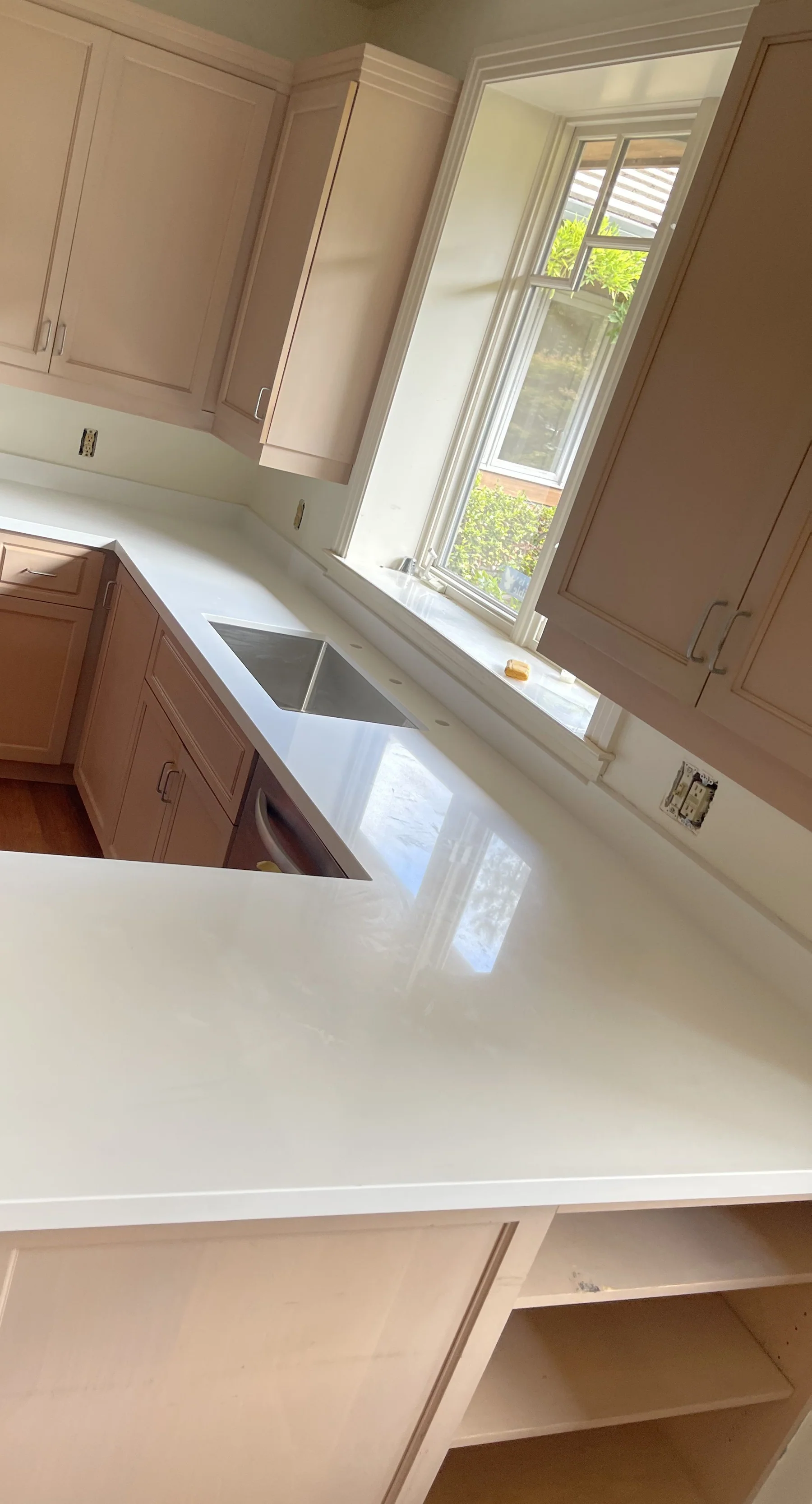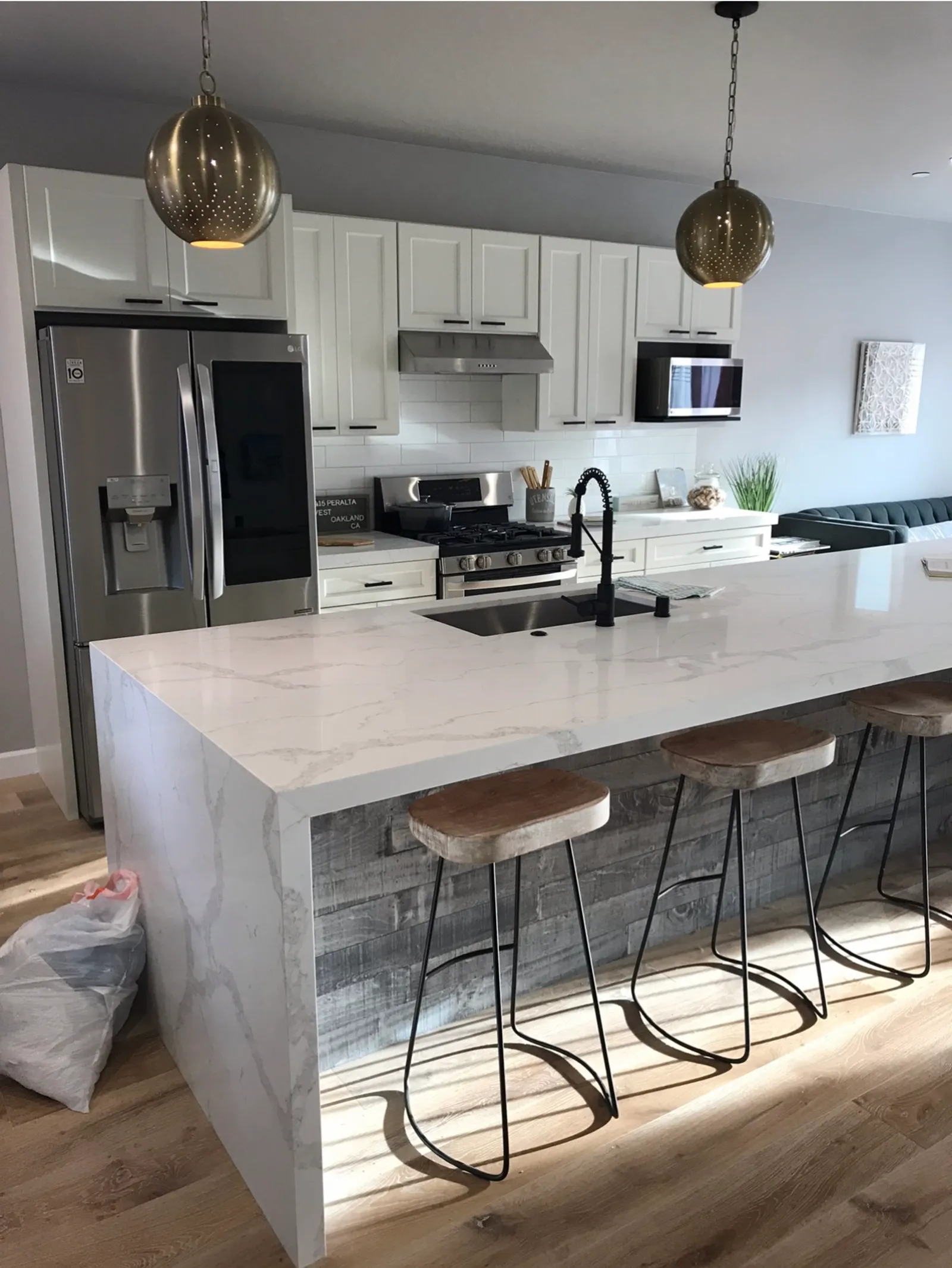
Pick the wrong countertop and it's the most visible mistake in your kitchen. Pick the right one and it's the surface that quietly does its job for 20 years. This is what we've learned installing them.
Most kitchens don't need a material-comparison essay — they need the honest version. Here's ours, based on what we actually install, what we actually charge (in ranges, because every kitchen is different), and what we refuse to do no matter how much it would save on the invoice.
What we install — the quick version
Of every countertop we install in Oakland, about 90% are quartz. The remaining 10% is roughly split across granite, marble, quartzite, and butcher block. That's not a marketing statistic — that's the last two years of our calendar.
If you're choosing between materials, the real question isn't which is prettiest. It's which level of maintenance you want to sign up for, and how permanent you want the decision to feel. Quartz sits in the middle of both scales. That's why most people land there.
The five materials we install
Quartz (Caesarstone, Silestone, MSI Q, Cambria) — engineered from natural quartz crystals bound with resin. Non-porous. No sealing. Consistent look from slab to slab. Hates extreme heat and direct UV.
Granite — igneous rock, quarried and polished. Every slab is different. Needs sealing annually. Holds up to heat. Classic look that doesn't go out of style.
Marble — metamorphic rock, usually Carrara or Calacatta. Highest-end appearance, highest maintenance. Etches from citrus, stains from red wine, scratches if you cut on it. Perfect for a bakery, questionable for a family kitchen.
Quartzite — natural stone often confused with quartz (different material entirely). Hardest of the natural stones. Needs sealing. Usually priced at marble levels.
Butcher block — maple, walnut, or teak. Budget-friendly for islands or prep counters. Requires oiling and sanding over time. Not a whole-kitchen material, but perfect for an accent island.
What it costs (honestly)
We install quartz often enough to have real tiers worth publishing. For the other four materials, we're giving Bay Area market ranges we see — not invented numbers, because we don't install enough granite or marble in a year to publish a reliable Soto Bay tier.
Quartz Pricing — Real Soto Bay Tiers (what we install most)
| Tier | Brands | Range |
|---|---|---|
| Budget | Caesarstone core, Silestone core | $50–80/sqft installed |
| Mid | MSI Q, upper Caesarstone | $75–110/sqft installed |
| Premium | Cambria, Calacatta-pattern quartz | $100–150/sqft installed |
Granite, Marble, Quartzite & Butcher Block — Bay Area Market Ranges
| Material | Typical Bay Area Range | Notes |
|---|---|---|
| Granite | $40–120/sqft installed | Slab-dependent; exotic stones run higher |
| Marble | $80–200+/sqft installed | Carrara is the affordable end; Calacatta Gold is the high end |
| Quartzite | $80–180/sqft installed | Often priced like marble; harder and less porous |
| Butcher block | $30–80/sqft installed | Maple is budget; walnut and teak run higher |
Anyone who quotes you "granite is $45/sqft installed" without seeing your kitchen is quoting a slab, not a job. Edge profile, seams, sink cutout, plumbing reconnect, and subtop work are where the real number comes from.
The install sequence — 5 days from template to stone
Once you've picked a slab, the clock starts. Here's what five days actually looks like:
A templater comes to your house with either a laser template tool or traditional plywood templates. Existing countertops need to be either out (most cases) or ready for final demo. Templating takes 2–3 hours. Sink location, faucet hole count, edge profile, and any radiused corners are finalized here. Change your mind after template day and you reset the clock.
Our fabricator partner cuts, polishes, cuts the sink opening, and profiles the edge. Good fabrication isn't fast — rushing a fabrication rushes a polish, and a rushed polish shows under kitchen lights.
Old countertops come out. Plywood subtop gets evaluated (more on that below). New stone gets set with adhesive. Set takes 4–8 hours depending on kitchen size and number of pieces. Adhesive needs 24 hours to cure before you put stress on it.
Faucet, sink, dishwasher connections, and garbage disposal all get put back. You can use the kitchen again — carefully.
If you're adding or changing the backsplash, that's 1–3 days on top, depending on tile choice and layout complexity.
Honest "back in service" timeline: 2 days minimum before you can actually use the kitchen, 4–6 days if you're doing backsplash at the same time.
Why we place seams through the sink cutout
This one catches homeowners off guard.
For any countertop run over about 10 feet, you'll have at least one seam. Where that seam lives is a choice — and most homeowners assume we'll put it in the least obvious spot.
We actually put it in the most obvious spot: right through the center of the sink cutout.
Here's why. A sink cutout removes about 24 inches of countertop width. If the seam runs through the middle of that cutout, the only visible seam is the 2–3 inches in front of the sink and the 2–3 inches behind it. With matching epoxy tinted to the stone, that 4–6 inches of visible seam practically disappears.
The alternative — putting the seam in the middle of a run, or near a cooktop, or in a corner — means you see the seam every time you prep, cook, or wipe down.
The plywood subtop (the thing nobody mentions in the sales pitch)
About 90% of countertop jobs need new plywood on top of the cabinets. That's not a hidden surprise — it's a standard scope item that ends up on the quote.
The two conditions where we skip it:
- The existing plywood subtop is in perfect condition — no rot, no cupping, no damage near the sink
- The new sink cutout matches the existing one exactly
Both conditions need to be true. Usually at least one fails. Why:
- Under-sink plywood takes 10–20 years of minor water exposure. It's almost always soft or discolored by the time you're changing countertops
- Sink cutouts that worked for a 30" drop-in don't match a 33" undermount farmhouse sink
- New stone is heavier than old laminate or tile; the subtop needs to be rated for the load
- Quartz manufacturers' warranties usually require a proper substrate
When plywood replacement lands on the quote, it's typically a few hundred dollars depending on kitchen size. Skipping it when it's needed is why some countertop jobs fail in year 3.
What we refuse to do
Install new countertops over existing tile countertops. Some contractors will quote this as a cost-saver: leave the old tile countertop in place, skip the demo down to bare cabinets, and install new stone on top. We don't do it. It never works.
Here's what goes wrong:
- Final countertop height ends up 1–2 inches too tall for your appliances, your backsplash, your existing plumbing
- Old tile adhesive creates an uneven base — the new stone sits on a wavy surface, which means stress points that crack
- Old plywood underneath is invisible to both you and the contractor until problems start
- Cabinet load wasn't planned for the added weight on an already-built-up surface
The right way is unglamorous: demo down to the cabinet boxes, evaluate the plywood, replace it if needed, then build up from there. It's the slow version. It's also the version that lasts 20 years.
What homeowners get wrong
- Chasing the lowest $/sqft. The price per square foot is maybe 60% of the real cost. Subtop, plumbing reconnect, fabrication, edge profile, and seam count are the other 40%.
- Treating quartz as indestructible. It's not. It hates direct heat (use a trivet for hot pans) and direct UV (don't put quartz under a south-facing window without a blind).
- Choosing marble for a high-use kitchen. Marble is beautiful. It also etches from lemon juice, stains from red wine, and scratches if you cut on it. If you love the marble look but need durability, we install marble-look quartz every month.
- Measuring the slab themselves and ordering online. Remote templating fails. Even a 1/8" error on a 10-foot run can mean a slab that doesn't fit.
Maintenance by material
Countertop Maintenance — By Material
| Material | Daily | Monthly | Annual |
|---|---|---|---|
| Quartz | Wipe with mild soap | — | — |
| Granite | Wipe with stone-safe cleaner | — | Re-seal |
| Marble | Wipe immediately after spills | Check for etching | Re-seal |
| Quartzite | Wipe with stone-safe cleaner | — | Re-seal |
| Butcher block | Wipe dry | Oil with cutting-board oil | Sand + reseal if needed |
Quartz is close to zero-maintenance. Natural stones want sealing annually. Marble wants you to be careful.
How countertops fit the bigger picture
If you're doing a full kitchen remodel, countertops come near the end — after flooring is installed and cabinets are set, but usually before the backsplash. The install-sequence decision matters for timing and budget.
Countertops aren't just a kitchen thing — vanity tops in bathroom remodels follow the same template → fab → install process (shorter, since they're smaller). Our Oakland bathroom cornerstone walks through vanity work in the context of the full bath sequence.
If you're specifically looking at quartz in a specific East Bay city, we have pages covering the local pricing and logistics:
- Quartz Countertops in Oakland
- Quartz Countertops in Berkeley
- Quartz Countertops in Alameda
- Quartz Countertops in Emeryville
- Quartz Countertops in Piedmont
- Quartz Countertops in San Leandro
How to choose a countertop contractor in Oakland
Countertops are one of the most visible investments in a kitchen. The contractor you pick determines whether the surface looks tight in year 5 or starts failing in year 3.
- Confirm the CSLB license is active. California contractors must hold a valid license for work over $500. Look up any contractor at cslb.ca.gov. Soto Bay Construction holds CSLB License #1054501, active since 2019.
- Ask how they handle the plywood subtop. A good contractor will say "we evaluate it on every job and replace it about 90% of the time." A vague answer or "we just install over whatever's there" means they're skipping it.
- Ask where they place seams. Through the sink cutout is the honest answer. Anywhere else — middle of a run, near a cooktop, in a corner — means you'll see the seam daily.
- Ask about the fab shop. Who's cutting and polishing the stone? Good contractors work with established fabricators and can tell you the 5-day template-to-install timeline without flinching.
- Ask whether they'll install over existing tile countertops. If yes, pick another contractor. It never works long-term and sets up problems you'll pay to fix later.
FAQ
How long does a countertop install take? Five days from template to install, plus 24 hours of adhesive cure, plus another 1–3 days if you're adding backsplash. So 2 days minimum before you can use the kitchen, 4–6 days if you're doing backsplash at the same time.
Do I need a permit? Not for a straight swap-out using existing plumbing. Yes if you're moving the sink location, changing gas lines, or doing significant plumbing reroutes.
How many seams will I have? Depends on kitchen size and slab dimensions. A typical U-shaped kitchen usually has 1–2 seams. We place them through sink or cooktop cutouts so they're not visible during normal use.
Quartz or granite? Quartz if you want less maintenance and a more consistent look. Granite if you want natural variation and are OK re-sealing once a year. Both hold up well — they're different aesthetic and maintenance profiles.
Can I keep my old sink? Usually yes, if it's in good shape and the cutout fits. We often replace the sink at the same time because a new countertop highlights a tired sink.
Why does the fab shop take 4 days? Cut, polish, edge profile, sink opening, backsplash pieces, dry-assemble. Good fabrication isn't fast. Rush fabrication and you see the polish quality every time you wipe the counter down.
What's a "Bay Area market range"? It's what we see slabs and installs running across quality contractors in our metro. Your actual quote comes from a walkthrough where we see the kitchen, talk through sink and edge decisions, and scope the plywood work.
Thinking about new countertops in Oakland?
Licensed since 2019. Family-owned. Real Oakland projects, real pricing, real timelines.
Get a Free Estimate